17 Reductions for Survival Analysis
This part of the book introduces and formalizes the concept of reduction for survival analysis. A reduction is defined as “a complex problem decomposed into simpler subproblems so that a solution to the subproblems gives a solution to the complex problem” (Beygelzimer et al. 2016). Reduction techniques can simplify the application of machine learning methods to survival analysis in two ways: by transforming a survival task to a regression or classification task, allowing use of standard machine learning methods; and by transforming an event history analysis task into a set of single-event tasks, allowing the use of single-event machine learning methods. As will be seen in the upcoming chapters, the two reduction paradigms can also be combined.
A reduction is only useful if the resulting predictions remain statistically meaningful for the original survival task. For example, some approaches treat the event indicator as a target for a classification task or directly use the observed time as a target for a regression task while ignoring the censoring status (Schwarzer et al. 2000). The reduction methods presented in this book are based on clear theoretical foundations and are constructed so that the resulting predictions can be meaningfully interpreted for the intended prediction task. Furthermore, the reductions in the following chapters do not make strong assumptions about the underlying distribution of event times and thus have similar advantages to non-parametric (Section 11.1) and semi-parametric methods (Section 11.2). The reductions included here can be applied to many survival tasks, including competing risks and multi-state settings (Chapter 4), and can predict the most common survival prediction types (Chapter 5).
The general pipeline for survival reduction techniques is depicted in Figure 17.1. In the training phase (Figure 17.1, top), the data are transformed into a different format with the specifics of the transformation dependent on the reduction technique and survival task at hand. Once the data are transformed, the target variable becomes a one-dimensional vector suitable for a regression or classification task while still encoding censored event-time information. At this stage, a standard machine learning model for regression or classification can be applied to the transformed data without any additional changes to the model or its implementation. In the prediction phase (Figure 17.1, bottom), if necessary, the test data are transformed into the same format as the training data using any transformation parameters obtained during training. This yields a dataset that can be passed to the previously learned regression or classification model to generate predictions. Depending on the reduction technique and the target quantity, the predictions may require additional post-processing to obtain the quantity of interest.
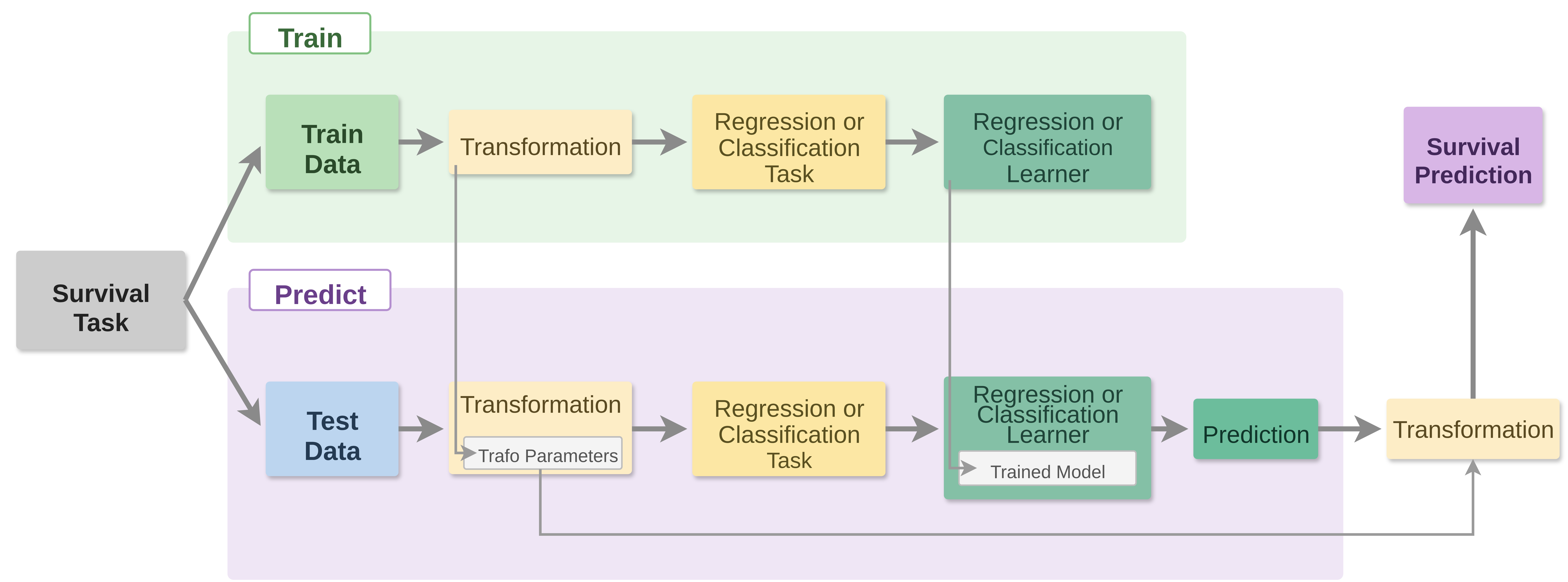
The following chapters introduce specific reduction techniques. The first technique transforms the survival problem to binary classification to estimate survival probabilities at a set of fixed times (Chapter 18). This applies to right-censored data only but is particularly useful when there are only a few time points of interest, the dataset is very large, or computational resources are limited. The second reduction transforms the problem into a regression task (Chapter 19). Like the classification approach, this method can estimate survival probabilities at fixed times but may also be used to estimate many other important quantities, including the restricted mean survival time, and is also applicable to event history analysis. However, this flexibility comes at a computational cost, especially when many time points are considered or the dataset is large. The partition-based reductions in Chapter 20 aim to estimate the entire event time distribution rather than a handful of time points. They are therefore particularly useful when complete survival curves or other distributional summaries are required. Finally, Chapter 21 introduces reductions that allow event history analysis to be expressed in terms of single-event tasks, which allows many of the models in Part III to be applied to competing risks and multi-state settings.
An empirical comparison of these reduction techniques, including benchmark experiments and simulation studies, is provided in Piller et al. (2026).